Un logiciel PIM (Product Information Management) gère et diffuse l’information produit vers les canaux de vente ; un logiciel PLM (Product Lifecycle Management) gère le développement du produit, de la recette à l’étiquetage. Dans l’industrie agroalimentaire, les deux s’appuient sur un même socle : le référentiel produit interne.
PIM, PLM… deux sigles proches, deux promesses qui se ressemblent — « gérer les données produits » — et pourtant deux outils qui ne répondent pas au même besoin. Et une question que presque personne ne pose, alors qu’elle change tout : votre PIM doit-il être un système externe, ou un référentiel interne à votre entreprise ? Faisons le point.
Qu’est-ce qu’un logiciel PIM ?
Un logiciel PIM (Product Information Management, ou gestion de l’information produit) collecte, structure et diffuse les informations produits destinées à la commercialisation : descriptifs, visuels, caractéristiques logistiques, données réglementaires d’étiquetage, attributs attendus par chaque canal de vente.
Dans l’esprit des professionnels, le mot « PIM » désigne aujourd’hui le plus souvent les plateformes de catalogues électroniques et les data pools : Equadis, Alkemics (SupplierXM), Akeneo, Agena3000, ou encore le data pool GS1. Ces systèmes jouent un rôle essentiel : ils permettent aux distributeurs et aux sites e-commerce de recevoir des fiches produits complètes, au bon format, dans les délais attendus. Chaque industriel qui référence ses produits en GMS ou en ligne doit les alimenter.
Qu’est-ce qu’un logiciel PLM ?
Un logiciel PLM (Product Lifecycle Management) gère le cycle de vie du produit côté conception et industrialisation : cahier des charges, formulation des recettes, sélection des matières premières et des fournisseurs, calcul des valeurs nutritionnelles et des allergènes, étiquetage réglementaire (INCO), emballages, jusqu’aux mises à jour et au retrait du marché.
Là où le PIM diffuse une information produit finalisée, le PLM la construit et la fait évoluer. Dans l’agroalimentaire, c’est le PLM qui garantit qu’une recette modifiée met automatiquement à jour la liste d’ingrédients, les allergènes et l’étiquette.
La distinction que tout le monde oublie : PIM interne ou PIM externe ?
La plupart des comparatifs opposent PIM et PLM comme deux briques concurrentes. C’est passer à côté de la vraie ligne de partage : où vivent vos données produits de référence ?
- Les PIM externes (Equadis, Alkemics, Akeneo, Agena3000, data pools GS1) sont des systèmes d’information situés hors de l’entreprise. Ce sont les distributeurs et les places de marché qui en définissent les attentes : l’industriel doit y déposer les informations demandées, dans les formats demandés. Indispensables pour vendre — mais ils ne gouvernent pas vos données : ils les reçoivent.
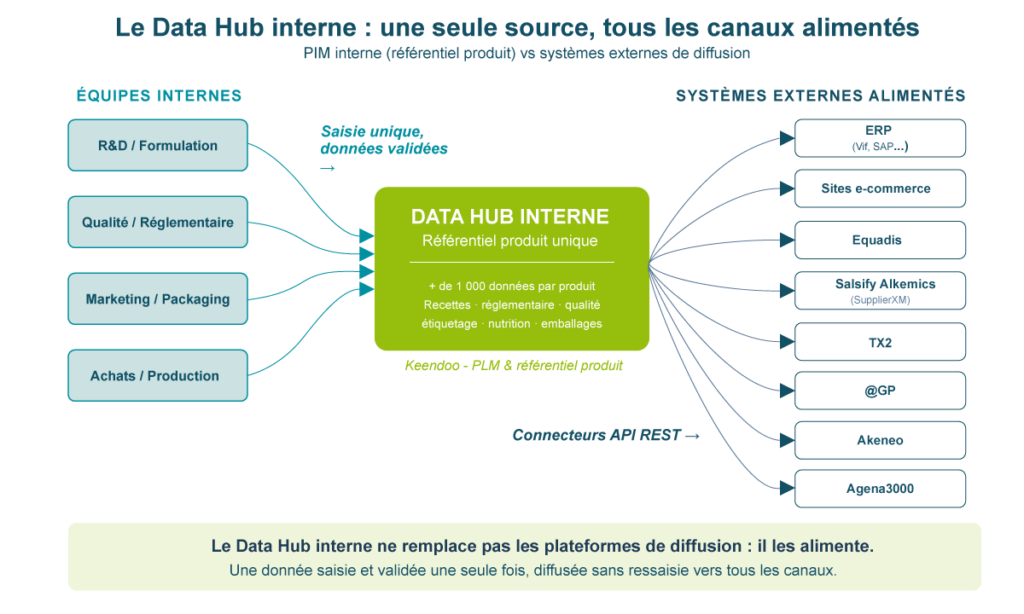
- Le PIM interne, lui, est un référentiel de données produits au cœur de l’entreprise, un Data Hub. C’est là que les données sont créées, contrôlées, validées et historisées, par les équipes R&D, qualité, marketing et achats. Une fois fiabilisées à la source, elles alimentent automatiquement les systèmes externes via des connecteurs (API REST) : catalogues électroniques, data pools, sites e-commerce, ERP.
La différence est structurante. Sans référentiel interne, chaque demande d’un distributeur déclenche une ressaisie manuelle dans chaque portail — avec les écarts et les erreurs que cela génère. Avec un Data Hub interne, la donnée est saisie une fois, validée une fois, et diffusée partout, toujours identique.
PIM ou PLM : lequel choisir dans l’agroalimentaire ?
| Votre besoin | L’outil adapté |
|---|---|
| Publier des fiches produits vers les distributeurs et l’e-commerce | PIM externe (catalogues électroniques, data pools) |
| Développer, formuler et mettre à jour vos produits (recettes, INCO, allergènes, emballages) | PLM |
| Centraliser et fiabiliser toutes les données produits de l’entreprise | Référentiel produit interne / Data Hub |
| Alimenter automatiquement les PIM externes sans ressaisie | Data Hub interne + connecteurs API REST |
En réalité, la question n’est pas « PIM ou PLM » : un industriel agroalimentaire a besoin des deux fonctions. La vraie question est : sur quel socle ? Si les données de référence vivent dans un référentiel interne unique, le PLM y construit les produits et les PIM externes y puisent des fiches toujours justes. Si ce socle n’existe pas, chaque outil devient un silo de plus.
Faire travailler PIM et PLM ensemble : l’approche Keendoo
Le référentiel produit Keendoo réunit les deux fonctions sur un socle unique : un PLM pour développer et faire vivre les produits, adossé à un Data Hub interne qui gouverne plus de 1 000 données par produit et alimente les systèmes externes — Equadis, Alkemics, Akeneo, Agena3000, data pools GS1 — via des connecteurs API REST, sans ressaisie.
Avec Quick Start PLM, ce socle est opérationnel en 3 jours pour les PME et ETI agroalimentaires, avec un interfaçage natif avec l’ERP VIF. Depuis plus de 10 ans, une cinquantaine d’industriels de l’agroalimentaire s’appuient sur Keendoo pour fiabiliser leurs données produits et accélérer leurs réponses aux distributeurs.
FAQ – PIM ou PLM
Le PIM (Product Information Management) diffuse l’information produit finalisée vers les canaux de vente ; le PLM (Product Lifecycle Management) construit cette information tout au long du développement du produit : formulation, réglementaire, nutrition, emballages. Le PIM commercialise, le PLM conçoit.
Non. Un PIM ne gère ni les recettes, ni les nomenclatures, ni les calculs nutritionnels et d’allergènes, ni les processus de développement. Inversement, un PLM seul ne diffuse pas les fiches produits vers les distributeurs. Les deux sont complémentaires et gagnent à partager le même référentiel de données.
Un PIM interne est un référentiel de données produits situé dans l’entreprise, un Data Hub, où les données sont créées, validées et historisées à la source. Il alimente ensuite les PIM externes (Equadis, Alkemics, Akeneo, Agena3000, data pools GS1) via des connecteurs API, sans ressaisie manuelle.
Les deux fonctions sont nécessaires : le PLM pour développer les produits (recettes, INCO, allergènes, emballages), le PIM pour répondre aux distributeurs et à l’e-commerce. L’essentiel est de les appuyer sur un référentiel produit interne unique intégré au PLM (PIM interne), garant de la cohérence des données qu’il diffuse sur tous les canaux, dont les PIM externes (Equadis, TX2, @GP…).
PIM ou PLM : ce qu’il faut retenir
PIM et PLM ne s’opposent pas : le PLM construit l’information produit, le PIM la diffuse. La décision structurante est ailleurs : disposer d’un référentiel produit interne, un Data Hub, qui gouverne les données à la source et alimente sans ressaisie les PIM externes, les data pools GS1, l’e-commerce et l’ERP. C’est ce socle qui transforme deux outils en une chaîne de données produits fiable, du développement du produit jusqu’au rayon.
Vous voulez voir comment un Data Hub interne alimente vos catalogues électroniques sans ressaisie?