Un référentiel produit est une base unique et partagée qui centralise toutes les données d’un produit (composition, informations réglementaires, emballages, documents) pour garantir leur fiabilité et leur cohérence dans toute l’entreprise. Dans l’agroalimentaire, un référentiel produit gère plus de 1 000 données par produit fini.
Composition, étiquetages réglementaires, Nutri-score, origine des ingrédients, recyclabilité des emballages, consignes de tri, logistique… Les industriels de l’agroalimentaire doivent maîtriser toujours plus de données pour satisfaire les exigences réglementaires et commerciales, et répondre aux attentes des consommateurs. Voici pourquoi et comment structurer votre référentiel produit.
Qu’est-ce qu’un référentiel produit ?
Le référentiel produit est la source de vérité unique de l’entreprise pour toutes les informations liées à ses produits. Il rassemble en un seul endroit, structuré et sécurisé, les données jusque-là dispersées entre l’ERP, les fichiers Excel des services R&D, qualité, marketing, achats, et les documents fournisseurs.
Concrètement, un référentiel produits contient : les recettes et formulations, les fiches techniques des matières premières, les données réglementaires (liste d’ingrédients, allergènes, valeurs nutritionnelles), les données d’emballage (composition, recyclabilité, consignes de tri), les certificats et cahiers des charges fournisseurs, ainsi que l’historique et les versions de chaque donnée.
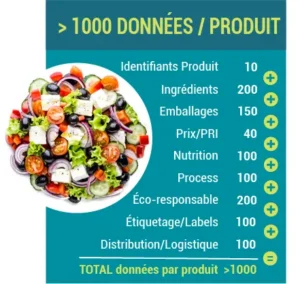
Plus de 1 000 données caractérisent un produit alimentaire, et davantage encore pour les produits complexes. Sans référentiel structuré, chaque service ressaisit, recopie et vérifie manuellement, avec les risques d’erreur et de non-conformité que cela implique.
Pourquoi les industriels de l’agroalimentaire en ont-ils particulièrement besoin ?
Le secteur agroalimentaire cumule des exigences que peu d’autres industries connaissent :
- Les exigences réglementaires s’intensifient : règlement INCO pour l’étiquetage, loi AGEC et règlement PPWR pour les emballages et l’information de tri, et les évolutions permanentes l’affichage environnemental. Chaque évolution réglementaire impose de retrouver, vérifier et mettre à jour les données de centaines de produits.
- Les exigences commerciales se multiplient : les distributeurs et sites e-commerce attendent des fiches produits complètes et à jour, transmises dans leurs formats et leurs délais.
- Les attentes des consommateurs portent sur la transparence : origines, labels, Nutri-Score, impact environnemental. Ces informations doivent être exactes et cohérentes sur tous les canaux : emballage, site web, catalogues électroniques, drives.
Un référentiel produit fiable est la condition pour répondre à ces trois pressions sans démultiplier la charge des équipes.
Référentiel produit, PLM, MDM, PIM : quelles différences ?
Ces termes se recoupent, mais ne désignent pas la même chose :
| Outil | Rôle | Position |
|---|---|---|
| Référentiel produit | Base unique qui centralise et fiabilise toutes les données produits | Cœur du système d’information, interne à l’entreprise : Data Hub |
| PLM (Product Lifecycle Management) | Gère le cycle de vie du produit : conception, modification, formulation, industrialisation, mise à jour | Interne : s’appuie sur le référentiel produit |
| MDM (Master Data Management) | Gouvernance des données de référence de l’entreprise (produits, mais aussi clients, fournisseurs…) | Interne |
| PIM externe / catalogues électroniques (Equadis, Alkemics, Akeneo, Agena3000…) | Diffusent les fiches produits vers les distributeurs et l’e-commerce | Externe — alimenté par l’entreprise |
La distinction entre PIM interne et PIM externe est détaillée dans notre article PIM ou PLM : quelles différences, et lequel choisir ?
Le référentiel produit Keendoo joue le rôle de Data Hub interne : il centralise et fiabilise les données à la source, puis alimente automatiquement les systèmes externes, catalogues électroniques, data pools GS1, sites e-commerce, via des connecteurs API REST. L’entreprise ne ressaisit plus ses données dans chaque portail : elle les gouverne en interne et les diffuse en un clic.
Comment construire et faire vivre son référentiel produit ?
- Rassembler et structurer : La première étape consiste à centraliser les données dispersées (ERP, Excel, messageries, documents papier) dans une base de données unique, avec un modèle de données adapté aux produits alimentaires : ingrédients, recettes, nomenclatures, emballages, documents liés, fiches produit ou fiches techniques.
- Collaborer pour fiabiliser : Un référentiel ne vit que si chaque service y contribue à son niveau : la R&D sur la composition des recettes, la qualité sur le réglementaire, les achats sur les données fournisseurs, le marketing sur les fiches produits et le packaging. Les workflows de validation garantissent que chaque donnée est vérifiée par la bonne personne, au bon moment, avant diffusion.
- Historiser et versionner : Chaque modification est tracée : qui a changé quoi, quand, et pourquoi. Les versions successives des recettes et des étiquetages restent accessibles : un atout décisif en cas d’audit (IFS, labels…) ou de gestion de crise (en cas d’alerte sanitaire par exemple).
- Diffuser des données contrôlées : Une fois validées, les données alimentent tous les usages : étiquetage, fiches techniques, catalogues distributeurs (PIM externe), calcul de scores, sans ressaisie, donc sans divergence.
Avec Quick Start PLM, les PME et ETI agroalimentaires disposent d’un référentiel produit pré-configuré pour leur métier, opérationnel en 3 jours, interfacé nativement avec l’ERP VIF. Keendoo accompagne depuis plus de 10 ans une cinquantaine d’industriels de l’agroalimentaire dans la structuration de leurs données produits.
FAQ — Référentiel produits
Un référentiel produit est une base de données unique et partagée qui centralise toutes les informations d’un produit : composition, données réglementaires, nutritionnelles, emballages et documents associés. Il garantit que tous les services de l’entreprise travaillent sur des données fiables, à jour et cohérentes.
Le référentiel produit est un Data Hub interne : il centralise et fiabilise les données à la source, dans l’entreprise. Les PIM de catalogues électroniques (Equadis, Alkemics, Akeneo, Agena3000…) sont des systèmes externes qui diffusent les fiches produits vers les distributeurs. Le référentiel interne alimente ces systèmes externes via des connecteurs API.
Il contient plus de 1 000 données par produit : recettes et formulations, ingrédients et allergènes, valeurs nutritionnelles, étiquetages réglementaires (INCO), données d’emballage et de recyclabilité (AGEC, PPWR), certificats fournisseurs, fiches techniques, historique et versions.
Avec une solution pré-configurée pour l’agroalimentaire comme Quick Start PLM de Keendoo, le référentiel produit est opérationnel en 3 jours, avec un modèle de données métier prêt à l’emploi et une interface native avec l’ERP VIF.