Le module Emballages du PLM Keendoo centralise toutes les données d’emballages de vos produits agroalimentaires (composition, recyclabilité, taux de recyclé, substances, contact alimentaire) dans un référentiel unique et partagé. Il consolide ces données au niveau du produit fini et les exploite pour vos déclarations (Citeo, TREE, décret QCE, Fost Plus…) et votre conformité au règlement européen PPWR.
Actualité réglementaire – Article mis à jour le 19 août 2026
Le règlement PPWR est applicable depuis le 12 août 2026. Pour savoir quelles données d’emballages détenir et comment prouver sa conformité, lire notre article PPWR 2026 : quelles données d’emballages faut-il détenir pour être conforme ?
Qu’est-ce que le PPWR et qu’est-ce qui change au 12 août 2026 ?
Le PPWR (Packaging and Packaging Waste Regulation), règlement (UE) 2025/40, est le nouveau règlement européen sur les emballages et les déchets d’emballages. Il remplace la directive de 1994 et s’applique directement dans tous les États membres à partir du 12 août 2026. Il couvre tout le cycle de vie de l’emballage, de la conception à la fin de vie.
Contrairement à une directive, un règlement n’a pas besoin d’être transposé pays par pays : les mêmes règles s’imposent partout, en France comme en Belgique. Le 12 août 2026 marque le début d’une montée en charge progressive, avec des exigences qui se renforcent jusqu’en 2040.
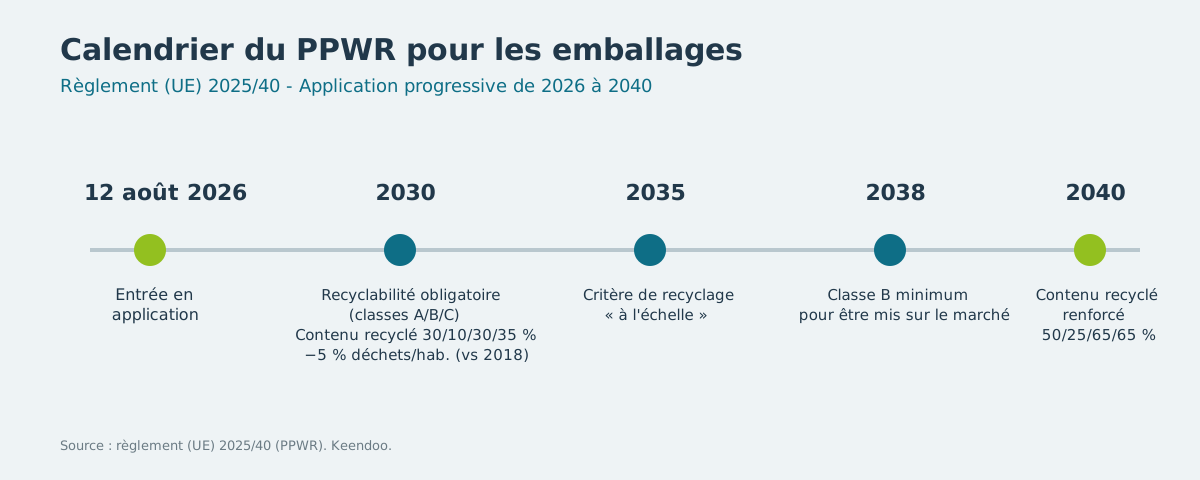
Le calendrier progressif du PPWR
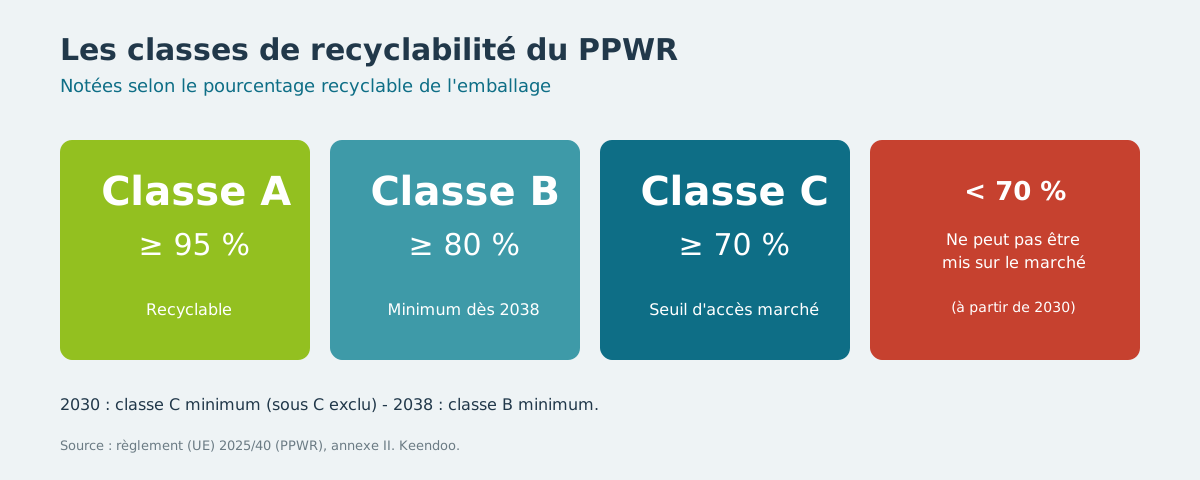
La recyclabilité des emballages est notée en classes de performance selon le pourcentage recyclable de l’emballage : classe A (≥ 95 %), classe B (≥ 80 %), classe C (≥ 70 %). En dessous de 70 %, l’emballage ne pourra plus être mis sur le marché. Les échéances : à partir du 1er janvier 2030, la recyclabilité est évaluée sur des critères de conception en vue du recyclage (les emballages sous la classe C sont exclus du marché) ; à partir de 2035, s’ajoute le critère de « recyclage à l’échelle » (recyclage effectif en volume) ; à partir du 1er janvier 2038, la classe B devient le minimum.
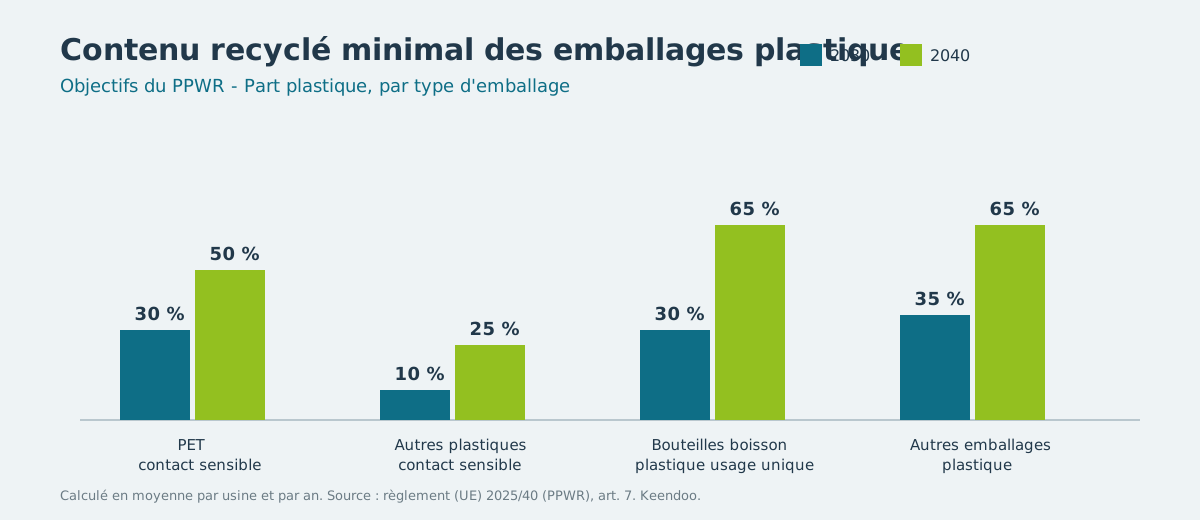
En parallèle, le contenu recyclé minimal de la part plastique des emballages devient obligatoire : au 1er janvier 2030, 30 % pour les emballages au contact de produits sensibles à base de PET, 10 % pour les autres plastiques au contact sensible, 30 % pour les bouteilles de boisson en plastique à usage unique et 35 % pour les autres emballages plastique. Ces seuils montent respectivement à 50 %, 25 %, 65 % et 65 % au 1er janvier 2040.
Les nouvelles exigences du PPWR pour l’emballage agroalimentaire
Au-delà de la recyclabilité et du contenu recyclé, le PPWR impose plusieurs obligations qui concernent directement les industries agroalimentaires : la réduction et la minimisation des emballages (le taux d’espace vide des emballages groupés, de transport et de e-commerce ne doit pas dépasser 50 %), une réduction des déchets d’emballages de 5 % par habitant d’ici 2030 par rapport à 2018, des objectifs de réemploi pour certains formats, un étiquetage harmonisé pour faciliter le tri, et une documentation technique prouvant la conformité de chaque emballage.
Le volet substances est particulièrement sensible pour le contact alimentaire : le PPWR restreint les PFAS dans les emballages destinés au contact avec les denrées alimentaires, au-delà de 25 ppb pour un PFAS mesuré individuellement, 250 ppb pour la somme des PFAS et 50 ppm pour les PFAS totaux. Les limites sur les métaux lourds (plomb, cadmium, mercure, chrome hexavalent) sont maintenues.
Le point commun de toutes ces exigences : chacune repose sur une donnée d’emballage précise, à jour et prouvable. Impossible de démontrer une classe de recyclabilité, un taux de recyclé ou l’absence de PFAS sans données structurées et fiables.
Quelles données d’emballages le PPWR exige-t-il ?
- composition des matériaux (couche par couche),
- classe de recyclabilité (A, B ou C),
- taux de matière recyclée,
- substances et contact alimentaire (dont PFAS),
- poids et format, pour la minimisation.
Pourquoi un référentiel de données d’emballages devient indispensable
En clair, le PPWR fait des données d’emballages le socle de la conformité. Sans données fiables (composition, recyclabilité, taux de recyclé, substances, contact alimentaire…) impossible de prouver qu’un emballage respecte le règlement. Gérer ses données d’emballages pour le PPWR n’est donc plus une option, mais une obligation
Aujourd’hui, les équipes R&D et Qualité Emballages gèrent ces informations dans des fichiers Excel, des fiches techniques dispersées, l’ERP ou des espaces partagés. Résultat : préparer une déclaration ou répondre à un cahier des charges devient un travail de collecte et de recoupement long et risqué, certains industriels mobilisent plusieurs personnes pendant des mois pour une seule campagne déclarative.
Le PPWR ajoute une couche d’exigences à cet édifice déjà complexe. Sans référentiel unique, chaque nouvelle obligation multiplie les recherches, les ressaisies et les risques d’erreur. C’est pourquoi centraliser les données d’emballages dans un référentiel partagé n’est plus une commodité, mais une condition de conformité.
Le module Emballages Keendoo : centraliser, consolider, exploiter
Le module Emballages est le référentiel de données d’emballages du PLM Keendoo, conçu avec des industriels agroalimentaires pour les équipes R&D et Qualité Emballages.
Centraliser les données de tous vos emballages
Chaque emballage est décrit dans un référentiel unique : codification et famille, format, dimensions et poids, composition matériaux couche par couche, caractéristiques techniques (couleur, opacité, fermeture, perméabilité, résistance), contact alimentaire, et l’ensemble des certificats et documents associés (alimentarité, fiches techniques, résultats d’analyses).
Consolider au niveau du produit fini
Le module Emballages regroupe tous les emballages qui composent une unité de vente consommateur (UVC) ou une gamme, calcule leur quantité en poids et consolide les informations de recyclabilité, de taux de recyclé et de réutilisation. Vous obtenez une vision complète de l’emballage d’un produit fini dans un seul écran.
Exploiter les données pour vos déclarations
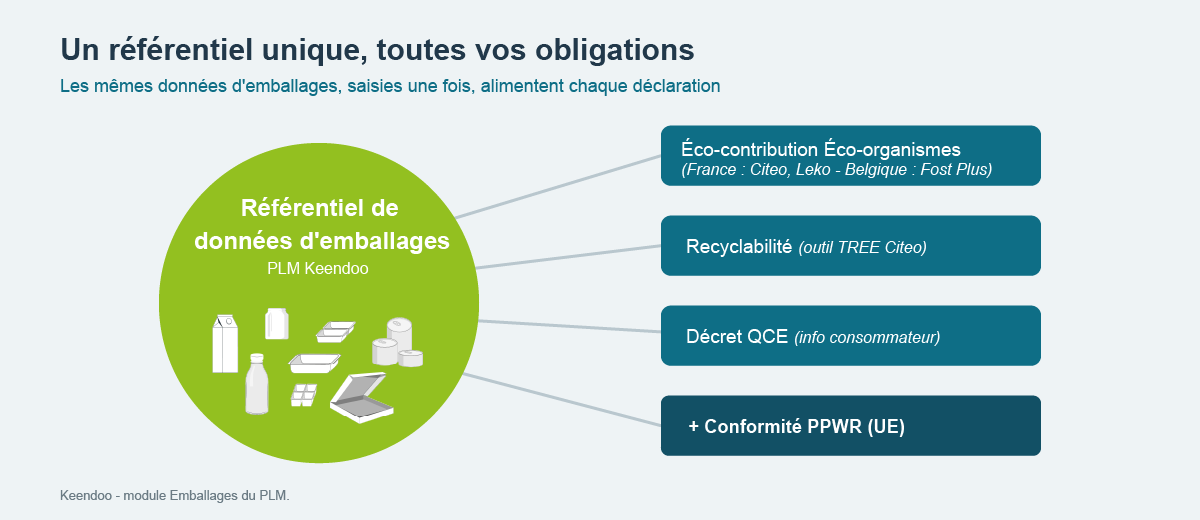
À partir de ce référentiel, le module prépare et exporte les données dans le format attendu par vos obligations : calcul de recyclabilité pour l’outil TREE de Citeo, déclaration d’éco-contribution Citeo, informations du décret QCE pour le consommateur, et réponses aux appels d’offres. Les mêmes données, saisies une fois, servent toutes vos déclarations, et demain votre documentation PPWR.
Recyclabilité des emballages : mesurer et piloter
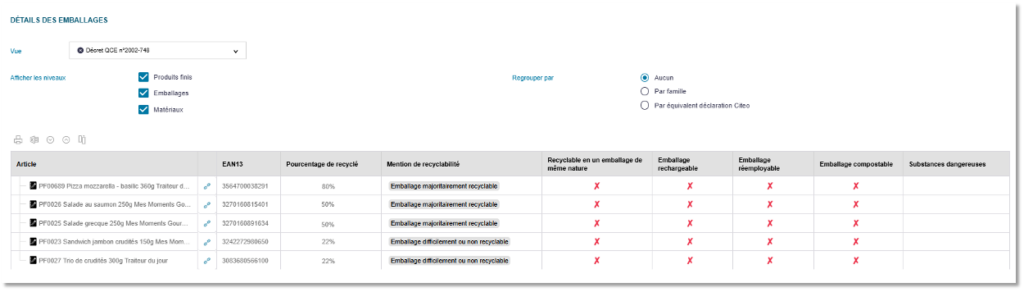
Pour répondre aux classes de recyclabilité du PPWR, encore faut-il pouvoir mesurer la recyclabilité de chaque emballage. Le module gère le pourcentage et le niveau de recyclabilité, la mention de recyclabilité, et prépare les données nécessaires au calcul dans l’outil TREE de Citeo. Vous suivez la recyclabilité de vos emballages recyclables au niveau de chaque référence comme au niveau du produit fini, et vous identifiez les emballages à faire évoluer avant les échéances de 2030 et 2038.
Contenu recyclé et réduction des emballages
Le module suit le pourcentage de matière recyclée par matériau et le pourcentage de recyclé global d’un emballage, la donnée exacte exigée par les objectifs de contenu recyclé du PPWR (2030 puis 2040). Couplé aux données de poids et de composition, il fournit aussi la base pour objectiver et réduire le poids et le volume de vos emballages, conformément aux exigences de minimisation.
Substances et contact alimentaire
C’est l’angle où la spécificité agroalimentaire fait la différence. Le module gère les substances sujettes à restriction (avec leurs limites de migration spécifiques, LMS), les substances dangereuses, les additifs, les couches barrières et le taux de MOSH/MOAH. Il permet de visualiser l’ensemble des substances apportées par un emballage et de tracer le contact alimentaire — de quoi documenter la conformité aux restrictions PFAS et aux règles applicables aux matériaux au contact des denrées alimentaires.
Déclarations et conformité : Citeo, Leko, TREE, QCE et Fost Plus en Belgique
En France, le module exploite déjà vos données pour l’éco-contribution Citeo ou Leko, le calcul de recyclabilité TREE et le décret QCE. En Belgique, il prend en charge les déclarations Fost Plus, l’éco-organisme qui gère les emballages ménagers. Vous pilotez ainsi vos obligations déclaratives des deux côtés de la frontière à partir d’un même référentiel, avec le PPWR comme socle réglementaire commun.
Des bénéfices concrets pour vos équipes R&D et Qualité Emballages
En centralisant et en fiabilisant les données d’emballages, vos équipes gagnent un temps considérable sur le reporting et les déclarations, accèdent à des données validées et à jour, répondent plus vite aux clients et aux appels d’offres, et se concentrent sur leur métier, l’innovation et l’optimisation des emballages, plutôt que sur la charge administrative. Elles abordent surtout les échéances du PPWR avec un référentiel prêt, plutôt que dans l’urgence.
Envie de voir comment centraliser vos données d’emballages et anticiper le PPWR ?
Questions fréquentes sur les données d’emballages et les obligations réglementaires
Le PPWR (Packaging and Packaging Waste Regulation), règlement (UE) 2025/40, est le règlement européen sur les emballages et les déchets d’emballages. Il remplace la directive de 1994, s’applique dans toute l’Union à partir du 12 août 2026 et couvre tout le cycle de vie de l’emballage, de la conception à la fin de vie (traitement et recyclage des déchets).
Le PPWR s’applique à partir du 12 août 2026, puis se renforce par étapes : recyclabilité obligatoire et premiers seuils de contenu recyclé en 2030, critère de recyclage à l’échelle en 2035, classe B minimum de recyclabilité en 2038, et objectifs de contenu recyclé renforcés en 2040.
Pour se conformer au PPWR, chaque emballage doit être documenté par des données précises : composition des matériaux, classe de recyclabilité, taux de recyclé, substances (dont les PFAS au contact alimentaire) et poids. Centraliser ces données d’emballages dans un référentiel unique permet de prouver sa conformité PPWR et d’alimenter ses déclarations (Citeo, Leko, TREE, décret QCE, Fost Plus…).
L’éco-contribution est la somme versée par les metteurs sur le marché à un éco-organisme (Citeo et Leko en France, Fost Plus en Belgique) au titre de la responsabilité élargie du producteur. Elle finance la collecte, le tri et le recyclage des emballages, et son montant dépend des caractéristiques de l’emballage (matériaux, poids, recyclabilité).
En les regroupant dans un référentiel unique, structuré par typologie d’emballage et partagé entre les équipes R&D, Qualité et Achats. Un module PLM dédié aux emballages, comme celui de Keendoo, centralise la composition, la recyclabilité, les substances et les documents, puis consolide ces données au niveau du produit fini (UVC ou UC).
Un PLM doté d’un module Emballages spécialisé pour l’agroalimentaire, capable de gérer nativement le contact alimentaire, les substances et les limites de migration, et d’exploiter les données pour les déclarations (Citeo, Leko, TREE, QCE, Fost Plus) et la conformité PPWR. Le module Emballages du PLM Keendoo est conçu pour cet usage.
En s’appuyant sur un référentiel de données d’emballages consolidé au niveau du produit fini, à partir duquel les informations nécessaires à la déclaration Fost Plus sont extraites. Le module Emballages Keendoo prend en charge les déclarations Fost Plus, comme il le fait pour Citeo en France.