Le PPWR, règlement (UE) 2025/40, s’applique dans toute l’Union européenne depuis le 12 août 2026. Il impose de documenter, pour chaque emballage mis sur le marché, sa composition matériau par matériau, son taux de contenu recyclé, sa classe de recyclabilité, ses substances préoccupantes et son aptitude au contact alimentaire.
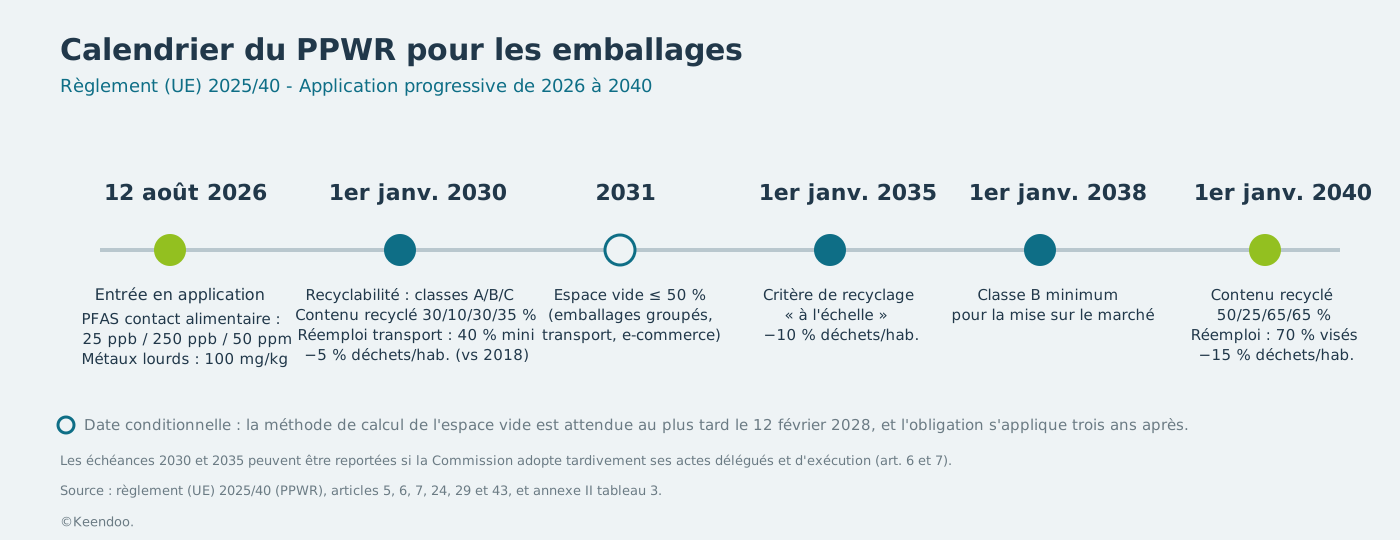
Ce que le PPWR change depuis le 12 août 2026
Le règlement (UE) 2025/40 relatif aux emballages et aux déchets d’emballages a été adopté le 19 décembre 2024 et publié au Journal officiel de l’Union européenne le 22 janvier 2025 [1]. Deux dates sont à distinguer, et elles sont souvent confondues. Le règlement est entré en vigueur le 11 février 2025. Il est applicable de manière générale depuis le 12 août 2026 [2].
À cette même date du 12 août 2026, la directive 94/62/CE sur les emballages et les déchets d’emballages a été abrogée. Certaines de ses dispositions continuent toutefois de s’appliquer [2].
Deux documents publiés par la Commission européenne en 2026 précisent les modalités pratiques. Des lignes directrices d’application à destination des opérateurs économiques et des États membres ont été publiées en mars 2026 [3]. Une foire aux questions officielle a été publiée le 3 août 2026, neuf jours avant l’application générale [4]. Ce second document répond aux questions pratiques remontées par les parties prenantes depuis l’adoption du règlement. Il n’existe pour l’instant qu’en anglais.
Qui est concerné dans l’agroalimentaire ?
Le champ d’application est large. Le règlement couvre tous les emballages mis sur le marché de l’Union européenne, vides ou remplis, quel que soit le matériau, qu’ils soient produits dans l’Union ou importés de pays tiers. Il couvre également tous les déchets d’emballages produits dans l’Union [4].
La définition d’un emballage est elle aussi large : tout article destiné à contenir, protéger, manipuler, livrer ou présenter un produit, y compris ses composants. Les éléments qui font partie intégrante d’un produit et qui sont éliminés avec lui sont en revanche exclus [4].
En pratique, pour une entreprise agroalimentaire, sont concernés les emballages primaires en contact avec la denrée, les emballages secondaires et les emballages de transport. Les fabricants, les importateurs et les distributeurs sont visés, y compris lorsque le produit est fabriqué pour le compte d’une enseigne sous marque de distributeur.
Un point mérite d’être signalé : le règlement prévoit des exclusions ciblées pour certains emballages de médicaments et de dispositifs médicaux, mais aucune exemption générale pour l’agroalimentaire [5].
Quelles données d’emballages le PPWR exige-t-il ?
C’est la question opérationnelle, et c’est celle qui détermine la charge de travail réelle. Chaque exigence du règlement se traduit par une donnée à détenir, à jour, et à produire sur demande.
| Donnée à détenir | Pourquoi le règlement l’exige | Référence |
|---|---|---|
| Composition matériau par matériau, couche par couche | La recyclabilité est évaluée par unité d’emballage | Annexe II, tableau 3 |
| Poids et répartition massique de chaque composant | L’évaluation de la recyclabilité se fait en termes de poids | Annexe II, tableau 3 |
| Type et format d’emballage | Les seuils s’appliquent par type et format d’emballage | Article 7, paragraphe 1, et annexe II, tableau 1 |
| Taux de contenu recyclé, par partie plastique | Seuils minimaux à respecter à horizon 2030 puis 2040 | Article 7, paragraphes 1 et 2 |
| Usine de fabrication de rattachement | Le contenu recyclé se calcule en moyenne par usine de fabrication et par année | Article 7, paragraphe 1 |
| Classe de performance en recyclabilité, A, B ou C | Conditionne la possibilité de mise sur le marché | Article 6, paragraphe 3, et annexe II, tableau 3 |
| Concentration en PFAS | Interdiction de mise sur le marché au-delà des seuils, pour le contact alimentaire | Article 5, paragraphe 5 |
| Concentration en plomb, cadmium, mercure et chrome hexavalent | La somme des quatre ne doit pas dépasser un seuil | Article 5, paragraphe 4 |
| Aptitude au contact alimentaire | Détermine l’application des seuils PFAS | Article 5, paragraphe 5 |
| Caractère réutilisable et rattachement à un système de réemploi | Objectif de part minimale d’emballages réutilisables | Article 29, paragraphe 1 |
| Taux d’espace vide, pour les emballages groupés, de transport et du commerce en ligne | Plafond à respecter | Article 24, paragraphe 1 |
Deux conséquences pratiques passent souvent inaperçues.
- La première concerne le calcul du contenu recyclé. Le règlement précise qu’il est calculé « comme une moyenne par usine de fabrication et par année » [6]. Ce n’est donc pas une caractéristique de l’emballage pris isolément, mais un résultat consolidé. Cela suppose de savoir, pour chaque référence d’emballage, de quelle usine elle provient, et de pouvoir agréger l’information sur un exercice complet.
- La seconde concerne la recyclabilité. L’évaluation se fait par unité et en termes de poids [7]. Une composition connue « en gros » ne suffit pas : il faut le détail couche par couche et le poids de chaque couche.
Les échéances à anticiper après 2026
Une seule exigence chiffrée s’applique déjà. Les autres portent sur 2030 et au-delà.
Ce qui s’applique depuis le 12 août 2026
Les emballages destinés à entrer en contact avec des denrées alimentaires ne peuvent pas être mis sur le marché s’ils contiennent une concentration de substances per- et polyfluoroalkylées, les PFAS, égale ou supérieure aux valeurs suivantes [8] :
| Seuil | Périmètre de mesure | Référence |
|---|---|---|
| 25 ppb | pour tout PFAS mesuré par une analyse ciblée, les PFAS polymères étant exclus de la quantification | Article 5, paragraphe 5, point a) |
| 250 ppb | pour la somme des PFAS mesurée comme la somme des analyses ciblées, le cas échéant avec dégradation préalable des précurseurs, les PFAS polymères étant exclus de la quantification | Article 5, paragraphe 5, point b) |
| 50 ppm | pour les PFAS, y compris les PFAS polymères | Article 5, paragraphe 5, point c) |
Par ailleurs, la somme des concentrations en plomb, cadmium, mercure et chrome hexavalent présentes dans les emballages ou leurs éléments ne doit pas dépasser 100 mg/kg [9].
Contenu recyclé dans les emballages en plastique
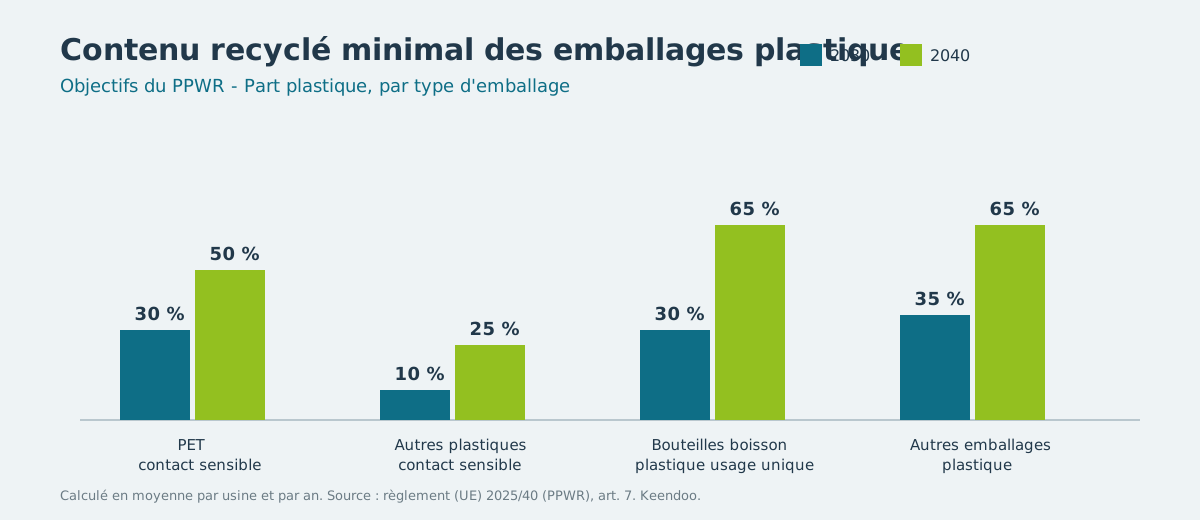
Les seuils s’appliquent au plus tard le 1er janvier 2030, ou trois ans après l’entrée en vigueur de l’acte d’exécution prévu par le règlement si cette date est postérieure [6].
| Catégorie d’emballage | 2030 | 2040 | Référence |
|---|---|---|---|
| Produits sensibles au contact, composant principal PET, hors bouteilles pour boissons en plastique à usage unique | 30 % | 50 % | Article 7, paragraphes 1 a) et 2 a) |
| Produits sensibles au contact, plastiques autres que le PET, hors bouteilles pour boissons en plastique à usage unique | 10 % | 25 % | Article 7, paragraphes 1 b) et 2 b) |
| Bouteilles pour boissons en plastique à usage unique | 30 % | 65 % | Article 7, paragraphes 1 c) et 2 c) |
| Autres emballages en plastique | 35 % | 65 % | Article 7, paragraphes 1 d) et 2 d) |
Recyclabilité
La recyclabilité s’exprime en classes de performance A, B ou C [7] :
| Classe | Seuil | Référence |
|---|---|---|
| Classe A | supérieure ou égale à 95 % | Annexe II, tableau 3 |
| Classe B | supérieure ou égale à 80 % | Annexe II, tableau 3 |
| Classe C | supérieure ou égale à 70 % | Annexe II, tableau 3 |
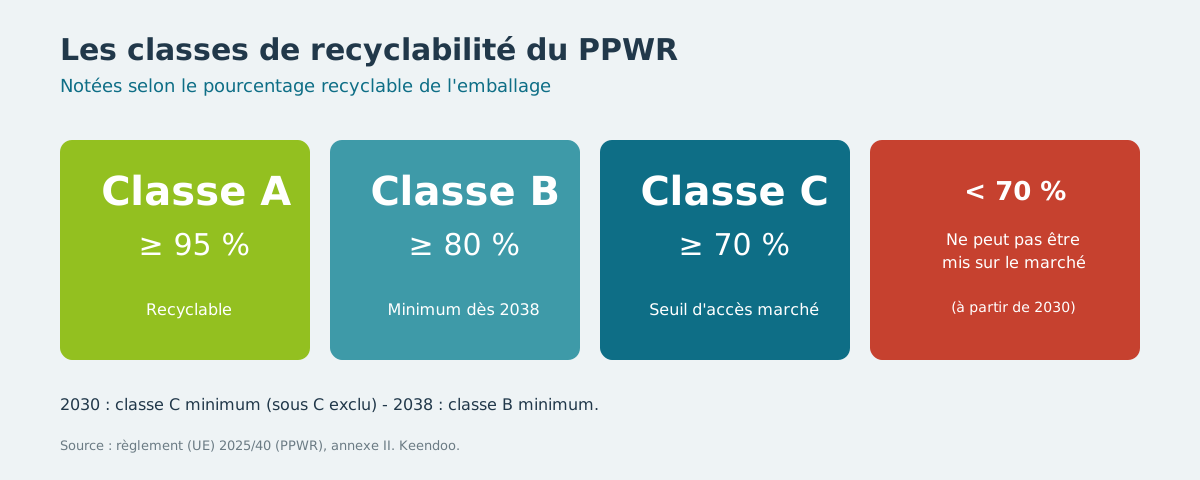
Le calendrier se déroule en trois étapes [10] :
- À partir du 1er janvier 2030, ou 24 mois après l’entrée en vigueur des actes délégués si cette date est postérieure, les emballages qui ne relèvent pas des classes A, B ou C ne peuvent plus être mis sur le marché.
- À partir du 1er janvier 2035, un critère supplémentaire s’ajoute, celui du recyclage à l’échelle [11].
- À partir du 1er janvier 2038, les emballages qui ne relèvent pas des classes A ou B ne peuvent plus être mis sur le marché.
Ces dates ne sont pas fermes pour la première échéance. Les critères de conception en vue du recyclage doivent être précisés par la Commission au plus tard le 1er janvier 2028 [12], et l’échéance de 2030 peut glisser de 24 mois si cette adoption est tardive.
Réemploi
À partir du 1er janvier 2030, les opérateurs économiques qui utilisent des emballages de transport ou de vente pour transporter des produits doivent veiller à ce qu’au moins 40 % de ces emballages soient réutilisables et relèvent d’un système de réemploi [13].
La liste des formats visés est directement parlante pour une chaîne logistique agroalimentaire : palettes, boîtes en plastique pliables, boîtes, plateaux, caisses en plastique, grands récipients pour vrac, seaux, fûts et bidons, quels que soient leur taille et leur matériau, y compris les formats souples, les emballages de palettes et les sangles utilisés pour stabiliser et protéger les produits pendant le transport [13].
À partir du 1er janvier 2040, ces mêmes opérateurs doivent s’efforcer d’atteindre au moins 70 % [13]. La différence de formulation est importante : 40 % en 2030 est une obligation de résultat, 70 % en 2040 une obligation de moyens.
Espace vide
Au plus tard le 1er janvier 2030, ou trois ans après l’entrée en vigueur des actes d’exécution correspondants si cette date est postérieure, le taux d’espace vide des emballages groupés, des emballages de transport et des emballages du commerce en ligne ne doit pas dépasser 50 % [14]. La méthode de calcul doit être établie par la Commission au 12 février 2028 [14].
Réduction des déchets d’emballages
Ces objectifs pèsent sur les États membres, et non directement sur les entreprises. Chaque État membre doit réduire la quantité de déchets d’emballages produits par habitant, par rapport à 2018, de 5 % d’ici à 2030, de 10 % d’ici à 2035 et de 15 % d’ici à 2040 [15].
L’effet pour les industriels est indirect mais réel : c’est par le durcissement des dispositifs nationaux, en France comme en Belgique, que ces objectifs se traduiront concrètement.
Les mesures qui touchent particulièrement l’agroalimentaire
- Restrictions de formats : Le règlement restreint certains emballages en plastique à usage unique, notamment les portions individuelles et les sachets de condiments et de sauces [2].
- Vente à emporter : Les entreprises de vente à emporter doivent offrir au client la possibilité d’utiliser son propre contenant, sans frais supplémentaires [2].
- Bouteilles en PET : La Commission a clarifié le 30 juin 2026 les règles de calcul du contenu recyclé des bouteilles en polyéthylène téréphtalate à usage unique, dans un objectif de transparence [16]. Le point concerne directement les producteurs de boissons.
- Indications géographiques et marques : Les exigences de réduction au minimum des emballages prévoient des exceptions, notamment lorsque le produit ou la boisson bénéficie d’une indication géographique protégée par le droit de l’Union, ou lorsque la réduction empêcherait une marque de distinguer le produit ou un dessin ou modèle de conserver ses caractéristiques [17]. Les normes harmonisées de calcul doivent être préparées à la demande de la Commission au plus tard le 12 février 2027 [17].
- Films et sangles de palettes : Une décision déléguée de la Commission exempte certains opérateurs économiques utilisant des films et sangles de palettes des exigences de réemploi [18]. Son articulation avec l’objectif de 40 % mérite d’être vérifiée au cas par cas.
Comment prouver sa conformité ?
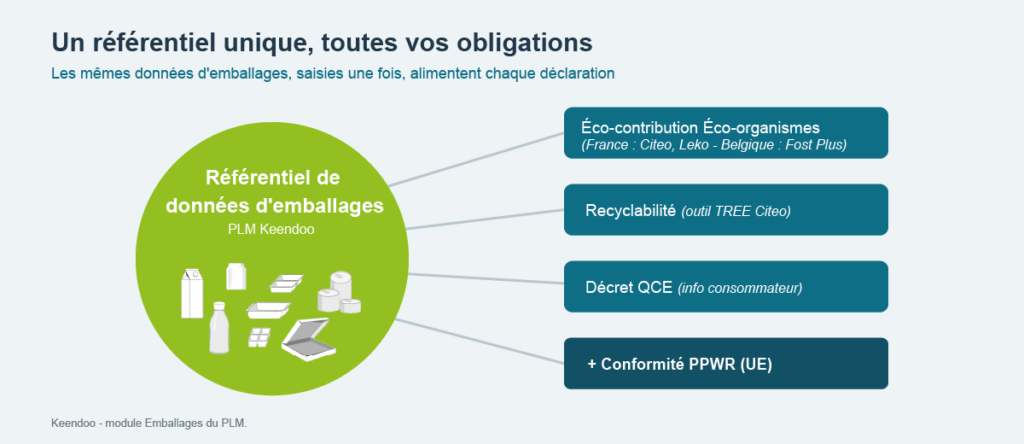
Le PPWR fixe des exigences européennes. Les déclarations, elles, restent nationales. Un industriel présent en France et en Belgique se retrouve donc à alimenter plusieurs dispositifs à partir des mêmes données d’emballage.
En France, la déclaration annuelle d’éco-contribution auprès de Citeo ou de Leko repose sur la nature et le poids des matériaux par unité de vente [19]. L’évaluation de la recyclabilité passe par l’outil TREE. Le décret relatif à la qualification du caractère écologique, dit décret QCE, ajoute ses propres exigences déclaratives.
En Belgique, la déclaration se fait auprès de Fost Plus pour les emballages ménagers [20], avec ses propres formats et échéances.
Le point commun de tous ces dispositifs est la donnée sous-jacente : la composition, le poids, le matériau, le taux de recyclé, la recyclabilité. Une donnée juste alimente toutes les déclarations. Une donnée approximative les fragilise toutes en même temps.
Du règlement à la donnée
La difficulté rencontrée par les équipes Qualité et R&D n’est pas de comprendre le règlement. Elle est de retrouver, pour plusieurs centaines de références, une information dispersée entre les fiches techniques des fournisseurs, des tableurs, l’ERP et les serveurs de fichiers.
Tant que la donnée d’emballage est dispersée, chaque déclaration est une campagne de collecte. Lorsqu’elle est consolidée en un point unique et rattachée à l’unité de vente consommateur, la déclaration devient un export. C’est le principe d’un référentiel de données d’emballages, dont la vocation est de rendre la preuve disponible à la demande plutôt que reconstituée dans l’urgence. Ce référentiel n’est pas un outil isolé. Il constitue l’un des domaines de données gérés par un logiciel PLM agroalimentaire, au même titre que les recettes, les fiches techniques ou l’étiquetage réglementaire.
Vous vous demandez où vous en êtes sur vos propres données d’emballages ? Nos équipes agroalimentaires peuvent vous aider à faire le point.
Questions fréquentes sur la conformité PPWR
Le PPWR est le règlement (UE) 2025/40 relatif aux emballages et aux déchets d’emballages. Il remplace la directive 94/62/CE et couvre tout le cycle de vie de l’emballage, de la conception à la gestion des déchets. Il s’applique à tous les emballages mis sur le marché de l’Union européenne, quel que soit le matériau.
Deux dates sont à distinguer. Le règlement (UE) 2025/40 est entré en vigueur le 11 février 2025. Il est applicable de manière générale depuis le 12 août 2026, date à laquelle la directive 94/62/CE a été abrogée, certaines de ses dispositions continuant de s’appliquer.
Depuis le 12 août 2026, les emballages au contact alimentaire ne peuvent plus être mis sur le marché si leur concentration en PFAS atteint 25 ppb pour un PFAS mesuré par analyse ciblée, 250 ppb pour la somme des PFAS ou 50 ppm PFAS polymères inclus, selon l’article 5, paragraphe 5. Les seuils de contenu recyclé et de recyclabilité, eux, s’appliquent à partir de 2030.
Tous les opérateurs qui mettent un emballage sur le marché de l’Union européenne : fabricants, importateurs et distributeurs, y compris pour les produits sous marque de distributeur. Le règlement prévoit des exclusions ciblées pour certains emballages de médicaments et de dispositifs médicaux, mais aucune exemption générale pour l’agroalimentaire, selon l’article 7, paragraphe 4.
La déclaration repose sur la documentation technique de chaque emballage : composition matériau par matériau, poids de chaque couche, taux de contenu recyclé par usine de fabrication et par année selon l’article 7, classe de recyclabilité selon l’annexe II tableau 3, et substances préoccupantes selon l’article 5. La conformité doit pouvoir être démontrée à la demande des autorités.
Le PPWR fixe les exigences européennes, les déclarations restent nationales. En France, l’éco-contribution est déclarée à Citeo ou Leko et la recyclabilité évaluée via l’outil TREE, avec les exigences du décret QCE. En Belgique, la déclaration passe par Fost Plus. Ces dispositifs s’appuient sur les mêmes données d’emballage.
Sources
- [1] Règlement (UE) 2025/40 du Parlement européen et du Conseil du 19 décembre 2024 relatif aux emballages et aux déchets d’emballages, modifiant le règlement (UE) 2019/1020 et la directive (UE) 2019/904, et abrogeant la directive 94/62/CE. EUR-Lex : https://eur-lex.europa.eu/eli/reg/2025/40/oj/fra
- [2] Commission européenne, direction générale de l’environnement, page « Déchets d’emballages » : dates d’entrée en vigueur et d’application, abrogation de la directive 94/62/CE, restrictions de formats et vente à emporter. https://environment.ec.europa.eu/topics/waste-and-recycling/packaging-waste_fr
- [3] Commission européenne, lignes directrices sur la mise en œuvre du règlement pour les acteurs économiques et les États membres, mars 2026. https://environment.ec.europa.eu/publications/guidance-document-packaging-and-packaging-waste-regulation-ppwr_en
- [4] Commission européenne, foire aux questions sur le règlement relatif aux emballages et aux déchets d’emballages, publiée le 3 août 2026. https://environment.ec.europa.eu/publications/faq-packaging-and-packaging-waste-regulation-ppwr_en
- [5] Règlement (UE) 2025/40, article 7, paragraphe 4, exclusions.
- [6] Règlement (UE) 2025/40, article 7, paragraphes 1 et 2, contenu recyclé minimal dans les emballages en plastique.
- [7] Règlement (UE) 2025/40, annexe II, tableau 3, classes de performance en matière de recyclabilité.
- [8] Règlement (UE) 2025/40, article 5, paragraphe 5, seuils PFAS dans les emballages au contact alimentaire.
- [9] Règlement (UE) 2025/40, article 5, paragraphe 4, plomb, cadmium, mercure et chrome hexavalent.
- [10] Règlement (UE) 2025/40, article 6, paragraphe 3, conditions de mise sur le marché selon la classe de recyclabilité.
- [11] Règlement (UE) 2025/40, article 6, paragraphe 2, point b), critère de recyclage à l’échelle.
- [12] Règlement (UE) 2025/40, article 6, paragraphe 4, actes délégués établissant les critères de conception en vue du recyclage.
- [13] Règlement (UE) 2025/40, article 29, paragraphe 1, objectifs de réemploi.
- [14] Règlement (UE) 2025/40, article 24, paragraphes 1 et 2, obligation relative aux emballages excessifs.
- [15] Règlement (UE) 2025/40, article 43, paragraphe 1, prévention des déchets d’emballages.
- [16] Commission européenne, communiqué du 30 juin 2026, clarification des règles de recyclage des bouteilles en plastique. https://ec.europa.eu/commission/presscorner/detail/en/ip_26_1467
- [17] Règlement (UE) 2025/40, article 10, réduction au minimum des emballages.
- [18] Commission européenne, décision déléguée exemptant certains opérateurs économiques utilisant des films et sangles de palettes des exigences de réemploi. https://environment.ec.europa.eu/publications/commission-delegated-decision-exempting-certain-economic-operators-use-pallet-wrappings-and-straps_en
- [19] Citeo, éco-organisme agréé pour les emballages ménagers en France. https://www.citeo.com
- [20] Fost Plus, organisme responsable des emballages ménagers en Belgique. https://www.fostplus.be/fr